


Synth-Pop Bangers : A Personal History and Playlist

Updated: 2 hours ago

Synth-Pop Bangers : A Personal History and Playlist
Synth-Pop Bangers traces the history of synth-pop not as a narrowly circumscribed genre or short-lived historical trend, but as a sweeping technological, cultural, and aesthetic transformation of popular music. The project explores how the synthesiser evolved from a space-age studio novelty and avant-garde texture into the primary instrument through which popular culture articulates technological modernity, urban alienation, and speculative futures. Emblematic of postmodern cultural practice, synth pop operates within a space of deliberate artifice. In these electronic soundscapes, surface glamour and plastic production function as "artefacts of paradox", generating complex, unexpected meanings by invoking both the utopian hopes and dystopian fears of late twentieth-century subcultures.
Growing up as a teenager in the 1990s, synth-pop often appeared to be a strangely rare or displaced commodity. The canonical electronic records of the 1980s belonged to a recent, closed past, while guitar-driven Brit pop, grunge, alternative rock, and underground rave culture dominated mainstream media. From an academic perspective, however, this period represents less an absence or death of the genre than a shift of fragmentation, latency, and assimilation. Rather than disappearing, the synthesiser's underlying technological vocabulary dissolved directly into the fabric of house, techno, Euro dance, and alternative dance. The foundational innovations of first-generation pioneers, from Kraftwerk and Giorgio Moroder to Gary Numan, The Human League, Depeche Mode, New Order, and Pet Shop Boys, became the ambient infrastructure of modern popular music.
With the turn of the twenty-first century, these synthetic codes resurfaced spectacularly through electro clash, electro pop, indie electronic music, French house, synth wave, and successive waves of 1980s retro mania. Framed by Zygmunt Bauman’s concept of retrotopia this resurgence was far from a gesture of passive reminiscence. Bootleg mashups, club remixes, and electro clash interventions—such as Richard X pairing Gary Numan’s cold synthesiser backing with contemporary vocals, or Kylie Minogue merging her pop hooks with New Order's "Blue Monday"—operated as "dialectic machines". They re-engineered historical electronic motifs to process the aesthetic and social anxieties of a new generation.

In the aftermath of the COVID-19 pandemic, popular culture has become more explicitly celebratory of this electronic inheritance than ever before. Contemporary artists and producers like Kungs and Purple Disco Machine have enthusiastically revitalised the syncopated bass lines, 124 BPM drive, and minor-key arpeggiators of Italo-disco, synth-pop, and hi-NRG for modern dance floors. As post-pandemic pop scholarship demonstrates, these high-energy productions couple dance floor euphoria with an inescapable pathos. By re-activating a unique spatiotemporal phenomenon, contemporary dance tracks connect modern listeners to the subterranean traumas and utopian possibilities of late-20th-century club culture—ranging from Cold War nuclear anxieties to the shadow of the AIDS crisis.
These 200 records map that multi-generational trajectory. By purposefully interweaving original album cuts alongside obscure production-library tracks, 12-inch club mixes, and bootleg mashups, the track list demonstrates how classic electronic motifs are continuously re-contextualised across decades. Ultimately, this curated archive illustrates synth-pop’s most profound historical repercussion: the synthesiser ceased to merely represent an imagined future and became the fundamental instrument through which popular music continually reinterprets its past, present, and imagined futures.
Louis & Bebe Barron – “Main Titles (Overture)” — Composed 1956 / Released September 1976
Created for MGM's landmark 1956 sci-fi film Forbidden Planet using custom-built electronic circuits, this soundscape stands as a founding document of the pre-synth-pop technological imagination. Though recorded during the dawn of the Space Race, MGM declined to issue an official soundtrack LP at the time, leading the Barrons to finally release the recording commercially on their own Planet Records label in September 1976. Operating outside conventional pop song structures, its non-traditional, cybernetic circuits and alien soundscapes prefigured the avant-garde electronic textures and dystopian atmospheres that would later permeate 1980s synth-pop.
Del Shannon – “Runaway” — 18 February 1961
Released by Big Top Records, Del Shannon’s chart-topping single spent three weeks at UK No. 1 and introduced an essential electronic prototype into mainstream popular music. The record’s defining feature is its extraordinary instrumental break, played by Max Crook on his home-built Musitron—a heavily modified Clavioline. By embedding a synthetic, highly futuristic solo directly into a classic rock-and-roll structure, Crook infused a standard doo-wop chord progression with an eerie, space-age quality, making the track a crucial technological ancestor of synthesizer-led pop.
The Tornados – “Telstar” — 17 August 1962
Issued on Decca, Joe Meek’s iconic instrumental reached UK No. 1 and became the first record by a British group to top the US Billboard Hot 100. Directly inspired by the launch of the Telstar communications satellite, the production transformed Space Race technological optimism into mass-market pop. Meek’s electronically treated keyboards, alien studio effects, and minimalist structural design established a clear aesthetic precedent for video-led futurism and synthetic pop music.
Ron Grainer / Delia Derbyshire – “Doctor Who” — 14 February 1964
Commercially issued by Decca (F 11837) in February 1964, this BBC Radiophonic Workshop arrangement remains one of television’s most influential electronic signatures. Realized by Delia Derbyshire through test oscillators, filtered noise, and painstaking manual tape manipulation, the arrangement bypassed conventional acoustic instrumentation altogether. In doing so, Derbyshire forged an enduring cultural link between synthetic timbres, alien landscapes, and speculative sci-fi narratives that profoundly shaped the visual and thematic vocabulary of later synth-pop.
Perrey & Kingsley – “Baroque Hoedown” — November 1967
First released on the Vanguard LP Kaleidoscopic Vibrations, this track showcases Jean-Jacques Perrey and Gershon Kingsley as early pioneers recording extensively with the Moog synthesizer. The composition demonstrated the playful, highly melodic possibilities of early synthesis, countering the perception of electronic music as purely cold or academic. The piece achieved multi-generational cultural longevity after Disney adopted its whimsical synthetic melody for the Main Street Electrical Parade in 1972.
Silver Apples – “Oscillations” — 1 June 1968
Opening Silver Apples’ self-titled debut on Kapp Records, “Oscillations” delivered a radical fusion of electronic noise and driving rock rhythms. Built around Simeon’s homemade bank of audio oscillators, the track eschewed traditional melodic ornament in favor of machine-like repetition and synthetic pulses. This uncompromising electronic-rock language directly prefigured Krautrock, post-punk, and the austere, rhythmic foundations of late-1970s synth-pop.
Gershon Kingsley – “Paperback Writer” — 15 January 1969
Featured on the Audio Fidelity LP Music to Moog By, Kingsley’s electronic interpretation of The Beatles illustrates the rapid migration of the Moog synthesizer out of specialist academic laboratories. By recasting a familiar commercial pop hit through synthetic timbres, the recording highlights a crucial late-1960s shift toward adopting synthesis as a flexible, lighthearted tool for popular songwriting.
Cecil Leuter – “Electro Sounds No. 8” — 1969
Composed by French library composer Roger Roger under his “Cecil Leuter” pseudonym, this track was issued on the 1969 production LP TVMusic 101. Operating entirely outside the conventional record industry and singles charts, this obscure library piece demonstrates that Moog experimentation and synthetic pulse design were simultaneously developing as background textures for broadcast media, quietly expanding the public's appetite for electronic sound.
Jean-Jacques Perrey – “E.V.A.” — May 1970
First appearing on Perrey’s Moog Indigo album issued by Vanguard Records in May 1970, this track never achieved contemporary UK singles chart status. However, its historical footprint expanded exponentially through sampling, as subsequent hip-hop and electronic producers repeatedly mined Perrey’s whimsical Moog arrangements and distinctive rhythmic construction.
Wendy Carlos – “Title Music from A Clockwork Orange” — 13 January1972
Recorded for Stanley Kubrick’s A Clockwork Orange, Carlos transformed Henry Purcell’s Music for the Funeral of Queen Mary into an eerie electronic processional using synthesizers. The recording was issued by Warner Bros. around the film’s release; contemporary 7-inch releases paired Carlos’s “March from A Clockwork Orange” with the theme. Its sinister electronic sound became inseparable from Kubrick’s dystopian imagery and anticipated the synthesizer’s central role in later electronic pop and film music.

Hot Butter – “Popcorn” — April 1972
Issued on Musicor Records in America in April 1972 before reaching UK No. 5, Gershon Kingsley's composition as realized by Hot Butter provided crucial commercial proof that a synthesizer-driven instrumental could function as a mass-market pop phenomenon rather than a novelty soundtrack.
Roxy Music – “Virginia Plain” — 4 August 1972
Released by E.G./Island, Roxy Music’s debut single reached UK No. 4 and introduced an art-school pop-art sensibility to British charts. Bryan Ferry’s lyrics, Brian Eno’s Minimoog treatments, and the band’s stylized visual artificiality established electronic texture and glamorous theatricality as core components of 1970s British pop.
Tangerine Dream – “Sequent C” — 20 February 1974
Peter Baumann’s brief flute-and-synthesizer piece closed Phaedra, released by Virgin Records on 20 February 1974. Reaching UK No. 15 with minimal traditional promotion, Phaedra established Tangerine Dream’s sequencer-driven "Berlin School" framework, profoundly shaping progressive electronic, ambient, and synthesiser composition.
Kraftwerk – “Autobahn” — 1 November 1974
The 22-minute title track of Kraftwerk's Philips LP (edited down for a UK No. 11 single) codified the band's motorik pulse, synthesised textures, and electronic percussion. By treating technology and modern transit as central artistic themes, Kraftwerk constructed a foundational blueprint for synth-pop, electro, hip-hop, and techno.
Brian Eno – “The Big Ship” — 14 November 1975
First released on Another Green World by Island Records, this instrumental builds emotional intensity through accumulating synthetic layers without relying on verse-chorus structures. It marked Eno’s transition from art-rock toward the atmospheric, non-linear composition that would define his ambient works.
Jean-Michel Jarre – “Oxygène (Part IV)” — 5 December 1976
First appearing on Oxygène (Disques Motors) in December 1976 prior to its UK No. 4 single release in 1977, Jarre’s expansive, wholly electronic composition demonstrated that non-vocal synth music could compete directly with mainstream pop singles.
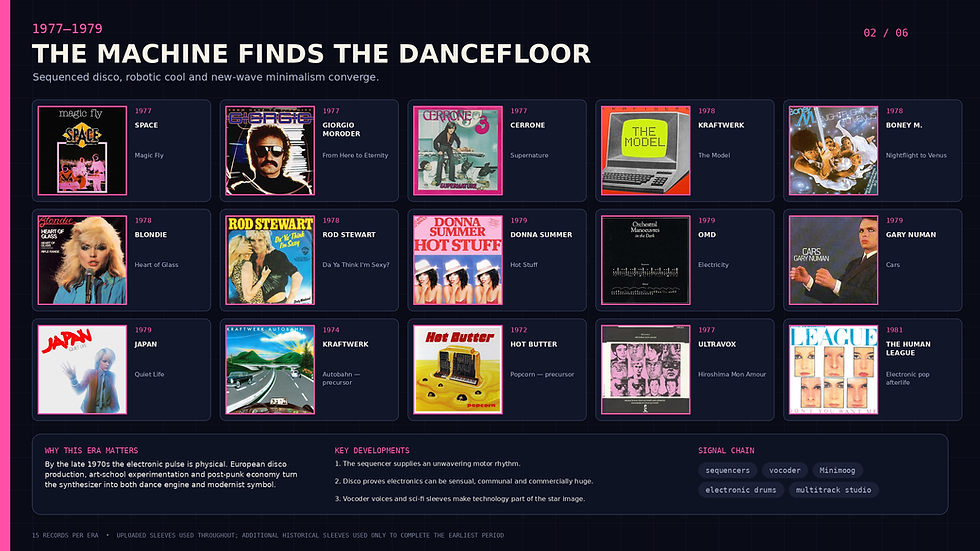
Space – “Magic Fly” — 1 April 1977
Appearing on Space's debut LP for Vogue before reaching UK No. 2 as a single, "Magic Fly" combined disco tempos with soaring synth leads and astronaut imagery, helping codify the European space disco subgenre.
Donna Summer – “I Feel Love” — 13 May 1977
Released on I Remember Yesterday (Casablanca) before reaching UK No. 1, Giorgio Moroder and Pete Bellotte’s Moog-driven production replaced traditional disco orchestration with relentless machine sequencing. The record remains a foundational catalyst for synth-pop, hi-NRG, techno, and electronic dance music.
Giorgio Moroder – “From Here to Eternity” — 22 July 1977
The title track of Moroder’s Casablanca LP (later a UK No. 16 single) extended the sequenced pulse of "I Feel Love," constructing a fully synthetic bridge between disco, hi-NRG, and late-1970s electronic pop.
Cerrone – “Supernature” — September 1977
Released on Malligator (Cerrone III) and reaching UK No. 8, Cerrone’s production wedded an ecological science-fiction narrative to a pounding synthetic disco arrangement, serving as a landmark European electronic dance production.
Ultravox! – “Hiroshima Mon Amour” — 7 October 1977
Issued as the B-side to "ROckWrok" on Island Records ahead of Ha!-Ha!-Ha!, this track combined Warren Cann’s Roland TR-77 rhythm machine with John Foxx’s cold vocal delivery. Taking its title from Alain Resnais’ 1959 French New Wave film on nuclear memory, it stands as an essential early synth-pop prototype.
Sylvester – “You Make Me Feel (Mighty Real)” — 7 January 1978
Featured on Fantasy Records' Step II (reaching UK No. 8), Patrick Cowley’s synthesizer arrangements transformed disco into hi-NRG, establishing a vital electronic framework for late-1970s LGBTQ+ club culture.
Kraftwerk – “The Model” — 28 April 1978
First released on The Man-Machine (Kling Klang/EMI) before its eventual 1982 UK No. 1 run, the track's detached observation of fashion culture and pristine electronic hook defined the minimalist vocabulary of 1980s synth-pop.
Boney M. – “Nightflight to Venus” — 23 June 1978
Opening Boney M.’s UK No. 1 album on Hansa/Atlantic, this track utilised robotic vocoder narration, electronic sound effects, and Frank Farian's Eurodisco production to construct a sci-fi launch sequence for mainstream pop audiences.
The Human League – “Being Boiled” — 30 June 1978.
This fills an important gap before Dare. Recorded extremely cheaply with synthesisers, microphone and tape recorder, it represents the original, austere Human League before their transformation into chart-pop stars. Gary Numan has specifically identified it as the record that showed him electronic music could retain a human quality.

Blondie – “Heart of Glass” — 23 September 1978
Featured on Chrysalis LP Parallel Lines prior to its 1979 UK No. 1 single release, "Heart of Glass" combined Roland drum machine pulses and synthesizers with new-wave rock, bridging downtown punk with electronic dancefloor production.
Giorgio Moroder – “Chase” — 6 October 1978
Composed for Alan Parker’s film Midnight Express (Casablanca Records, UK No. 48 single), its insistent sequenced synthesizer line became an influential template for electronic suspense scoring, hi-NRG, and club production.
Rod Stewart – “Da Ya Think I’m Sexy?” — November 1978
A striking electronic detour for the former Faces frontman, Stewart embraced disco with Duane Hitchings’ prominent synthesiser supplying the track’s futuristic hook and texture. The combination of synth, pulsing bass and four-on-the-floor rhythm demonstrated electronic dance production infiltrating mainstream rock. Released on Riva, it reached UK No. 1
Sparks – “The Number One Song in Heaven” — 1 March 1979
Opening Nº 1 in Heaven (Virgin Records, UK No. 14 single), Giorgio Moroder’s electronic production reinvented Sparks, establishing a blueprint for the British electronic pop duo format that flourished in the 1980s.
Donna Summer – “Hot Stuff” — 13 April 1979
Released on Casablanca (UK No. 11), Moroder and Pete Bellotte integrated Jeff "Skunk" Baxter’s rock guitar over an electronic disco chassis, winning the inaugural Grammy for Best Female Rock Vocal Performance and demonstrating crossover genre fluidity.
Tubeway Army – “Are ‘Friends’ Electric?” — 4 May 1979
Gary Numan’s Minimoog-dominated single spent four weeks at UK No. 1 via Beggars Banquet. Its unconventional length, lack of a traditional chorus, and dystopian narrative of artificial humans demonstrated that austere electronic post-punk could capture the mass market.
Orchestral Manoeuvres in the Dark – “Electricity” — 21 May 1979
OMD’s debut single for Factory Records (FAC 6) combined Kraftwerk-inspired electronic minimalism with a lyric addressing energy consumption, establishing the melodic, economical synth-pop style that influenced Britain's post-punk generation.
Gary Numan – “Cars” — 24 August 1979
Reaching UK No. 1 on Beggars Banquet, "Cars" replaced conventional guitar-led verse-chorus pop with dominant analogue synthesisers and a detached vocal, turning synth-pop into a major international commercial form.
The Buggles – “Video Killed the Radio Star” — 7 September 1979
Trevor Horn and Geoff Downes’ UK No. 1 single on Island Records made technological mediation both its central subject and musical vehicle. Its Russell Mulcahy-directed clip famously became the first music video broadcast on MTV in 1981.
ABBA – “Gimme! Gimme! Gimme! (A Man After Midnight)” — 12 October 1979
Released on Epic (UK No. 3), the song’s dramatic ARP Odyssey synthesiser motif provided one of pop’s most recognizable hooks, later sampled by Madonna for "Hung Up" in 2005.
Japan – “Quiet Life” — 7 December 1979
The title track of Japan's Hansa LP (later a UK No. 19 single in 1981) fused David Sylvian’s vocal style with synthetic textures and disco rhythms, outlining the sophisticated electronic aesthetics of the incoming New Romantic movement.
The early 1980s saw an explosion of synth in mainstream pop John Foxx – “Underpass” — 4 January 1980
Released on Virgin/Metal Beat on 4 January 1980, John Foxx’s solo debut reached UK No. 31. Recorded entirely with synthesisers and electronic percussion, the track discarded the traditional rock band setup. Its stark, cold vocal, architectural motifs, and J. G. Ballard-inspired vision of urban alienation established one of British synth-pop’s definitive early dystopian statements, evoking a cool, mechanical Ballardian melancholia.
Blondie – “Call Me” — February 1980
Written by Debbie Harry and Giorgio Moroder for the soundtrack to American Gigolo, the single was issued on Chrysalis in February 1980, entering the UK charts in April and topping both the UK and US singles charts. Moroder’s driving synthesiser arrangement merged Blondie’s downtown new-wave identity with electronic disco, serving as a vital historical bridge connecting late-1970s club culture with the upcoming 1980s synth-pop boom.
Roxy Music – “Same Old Scene” — 23 May 1980
First appearing on the album Flesh + Blood (E.G. Records) on 23 May 1980 ahead of its October single release (UK No. 12), the track relies on a prominent Roland CR-78 rhythm machine and sleek, shimmering synthesizers. It captures Roxy Music's evolution from 1970s glam-rock experimenters into polished architects of sophisticated electronic adult pop.
Ultravox – “Vienna” — 11 July 1980
First appearing on Ultravox’s Vienna album, this landmark synth-pop ballad fused Billy Currie’s sweeping synthesisers with electronic percussion, piano and violin, creating an unusually cinematic electronic sound. Produced with Conny Plank, it became a defining New Romantic recording. Released as a single in January 1981, it famously reached UK No. 2.
David Bowie – “Ashes to Ashes” — 1 August 1980
Released by RCA on 1 August 1980, the single became Bowie’s second UK No. 1. Revisiting Major Tom over an intricate web of synthesizers and guitar synths, its release was accompanied by David Mallet’s landmark solarized music video featuring London Blitz-club icons including Steve Strange, anchoring the visual language of the emerging New Romantic movement.
Orchestral Manoeuvres in the Dark – “Enola Gay” — 26 September 1980
Issued on Dindisc on 26 September 1980, “Enola Gay” reached UK No. 8 and became OMD’s breakout international single. Built upon a doo-wop-inspired four-chord progression and a siren-like metallic synth ostinato in place of a vocal chorus, Andy McCluskey’s lyric confronts the B-29 bomber that dropped the "Little Boy" atomic warhead on Hiroshima at 8:15 AM on 6 August 1945. Its deceptively bright electronic melody masks a haunting nuclear narrative, creating a juxtaposition that resonated deeply across 1980s pop culture.
Spandau Ballet – “To Cut a Long Story Short” — 31 October 1980
Released via Reformation/Chrysalis on 31 October 1980, Spandau Ballet’s debut single reached UK No. 5. Its sequenced synth-led dance pulse emerged directly out of London’s underground Blitz club scene, transforming New Romantic nightclub subculture into a highly visible, mainstream British pop phenomenon.
Visage – “Fade to Grey” — 14 November 1980
Issued by Polydor on 14 November 1980, “Fade to Grey” reached UK No. 8 and topped the charts in West Germany and Switzerland. Featuring austere synthesizer sequences, bilingual English/French spoken vocals, and frontman Steve Strange’s stylized visual presentation, the record remains the quintessence of the Blitz club's New Romantic electronic aesthetic.

Duran Duran – “Planet Earth” — 2 February 1981
Released by EMI on 2 February 1981, Duran Duran’s debut single reached UK No. 12. Driven by Prophet-5 and Roland Jupiter-4 synthesisers alongside a driving dance beat, the song framed an apocalyptic narrative of alien visitation post-nuclear destruction. Russell Mulcahy’s music video—ending with Simon Le Bon leaping into a void—established the band's signature mix of synth-pop and visual spectacle.
Vangelis – “Chariots of Fire” — March 1981
First appearing on the Polydor soundtrack LP in March 1981 before climbing to UK No. 12 and US No. 1, Vangelis’s majestic synthesiser composition proved that purely electronic, non-orchestral film scoring could achieve universal cultural recognition and mass-market chart dominance.
Iggy Pop – “Bang Bang” — 22 May 1981
A fascinating electronic excursion from punk’s great wild man. Co-written with Ivan Kral, whose keyboards help drive its mechanical new-wave pulse, “Bang Bang” places Iggy over synthesised textures and a dance-oriented rhythm rather than raw Stooges rock. Released on Arista, it reached No. 35 on Billboard’s Club Play chart.
Duran Duran – “Girls on Film” — 15 June 1981
First released on Duran Duran’s self-titled EMI debut album on 15 June 1981 (preceding the July single, UK No. 5), the track paired disco-inflected synth-pop with an infamous, controversial Godley & Creme music video, solidifying the group's mastery of the MTV-era promotional clip.
Soft Cell – “Tainted Love” — 17 July 1981
Issued by Some Bizzare/Phonogram on 17 July 1981, Soft Cell’s stripped-down cover of Gloria Jones’s 1964 soul track reached UK No. 1. Marc Almond’s vulnerable vocal set against Dave Ball’s minimalist synthesisers and rhythm programming demonstrated how modest electronic setups could reinvent classic songwriting into global pop hits.
The Human League – “Love Action (I Believe in Love)” — 31 July 1981
Released by Virgin on 31 July 1981, “Love Action” reached UK No. 3. Produced by Martin Rushent, the record utilised analogue synthesisers and micro-sequenced rhythms under Philip Oakey’s conversational vocals, signalling British synth-pop’s decisive move into mainstream chart dominance.
Depeche Mode – “Just Can’t Get Enough” — 7 September 1981
Issued by Mute Records on 7 September 1981, this Vince Clarke composition reached UK No. 8. Featuring an economical arrangement and an infectious, repetitive synth hook, it marked Clarke’s final single with Depeche Mode before departing to form Yazoo, marking a key structural turning point in early electronic pop.
The Human League – “Don’t You Want Me” — 16 October 1981
First released on the multi-platinum album Dare (Virgin) on 16 October 1981 prior to its November single release (UK No. 1 and Christmas No. 1), the track’s dual male-female narrative and Martin Rushent’s flawless synth production established synth-pop as a global commercial juggernaut.
Kim Wilde – “Cambodia” — 2 November 1981
Released on RAK Records on 2 November 1981, “Cambodia” reached UK No. 12 and topped charts across continental Europe. Produced by Ricky Wilde, its dark synth ostinatos and eerie, brooding atmosphere showcased a thematic shift toward geopolitical tension and mystery.
The Flirts – “Passion” — 5 February 1982
Issued through O Records on 5 February 1982, Bobby Orlando’s relentless synth production established an influential US club record. Its sequenced basslines, electronic pulse, and cool vocal delivery codified the hi-NRG blueprint that directly shaped European dance-pop and early Pet Shop Boys recordings.
Yazoo – “Only You” — 15 March 1982
Vince Clarke’s post-Depeche Mode masterpiece paired delicate, minimalist synthesizers with Alison Moyet’s rich, soulful vocal, demonstrating how electronic pop could feel intensely human rather than mechanical. Released on Mute, their debut single became a defining early synth-pop ballad, reaching UK No. 2 and establishing Yazoo immediately.
Men Without Hats – “The Safety Dance” — April 1982
First featured on the LP Rhythm of Youth in April 1982 before climbing to UK No. 6, Ivan Doroschuk’s upbeat synth single paired bright electronic hooks with a medieval-themed music video, becoming an international new-wave staple.
Tears for Fears – “Pale Shelter (You Don’t Give Me Love)” — 9 April 1982
An early expression of Tears for Fears’ atmospheric synth-pop, the original Mike Howlett-produced recording blended synthesizers, programmed textures and guitar beneath Curt Smith’s restrained vocal. Initially unsuccessful, it was re-recorded for The Hurting; that 1983 version transformed the song into a major hit, reaching UK No. 5.
A Flock of Seagulls – “Space Age Love Song” — 9 April 1982
Appearing on the band's self-titled Jive debut on 9 April 1982 (single May 1982, UK No. 34), Paul Reynolds’ reverberant guitar work merged with Mike Score’s synth textures to forge the futuristic, romantic sound signature of the Second British Invasion.
Patrick Cowley & Sylvester – “Do Ya Wanna Funk” — 1 July 1982
Released on Megatone MT-102 on 1 July 1982 (UK No. 32), Cowley’s rapid-fire synthesizer sequences and Sylvester’s soaring falsetto created an iconic hi-NRG club track closely tied to San Francisco's queer dance culture.
Yazoo – “Don’t Go” — 5 July 1982
Driven by Vince Clarke’s instantly recognisable Pro-One synth riff, “Don’t Go” turned electronic minimalism into exuberant pop. Alison Moyet’s powerful bluesy vocal provides a strikingly human counterpoint to the sequenced synthesizers and machine rhythms. Released on Mute, it became Yazoo’s second major hit, reaching UK No. 3.
Soft Cell – “…So” — 21 August 1982
Released on Some Bizzare/Phonogram as the B-side to “What!”, “…So” is essentially Dave Ball unleashed: an extended, disco-driven electronic workout built around sequencers, drum machines and a wonderfully sleazy club pulse. The parent single reached UK No. 3, while “…So” became a cult example of Soft Cell’s dancefloor experimentalism.
F. R. David – “Words” — 20 August 1982
Issued on Carrère on 20 August 1982, “Words” became one of continental Europe’s biggest synth-pop hits, subsequently reaching UK No. 2. Its minimal drum-machine pattern and delicate synth melodies proved European electronic pop could succeed globally without British New Romantic theatricality.
Simple Minds – “Someone Somewhere (In Summertime)” — 1 September 1982
First released on New Gold Dream (81, 82, 83, 84) by Virgin on 1 September 1982 (single Nov, UK No. 36), the track's shimmering synth layers captured Simple Minds' evolution from post-punk into expansive, atmospheric electronic pop.
Eurythmics – “Love Is a Stranger” — 17 September 1982
Released by RCA on 17 September 1982 (reissued in 1983 to reach UK No. 6), Dave Stewart’s pulsing electronic arrangement and Annie Lennox’s visually striking gender-fluid performance established Eurythmics as major international art-pop innovators.
Thomas Dolby – “She Blinded Me with Science” — 25 October 1982
Issued on Venice in Peril on 25 October 1982 (UK No. 49, US No. 5), Dolby’s single incorporated synthesizers, sequencers, and Magnus Pyke’s eccentric spoken interjections, making technophile fascination both the subject and medium of pop.
Wang Chung – “Dance Hall Days” — 29 October 1982
First released on Arista on 29 October 1982 under the group's original name Huang Chung (re-recorded in 1983, UK No. 21), this initial version represents the early electropop origins of the duo’s defining hit.
Bobby O – “She Has a Way” — 1982
Issued by O Records in 1982, Bobby Orlando’s pounding programmed rhythms and sequenced synthesizers exemplified his signature hi-NRG style, which heavily influenced the early writing and production aesthetic of Pet Shop Boys.
The Jetzons – “Hard Times” — 1983 (recorded; first released 2008)
A lost slice of American new wave, “Hard Times” was recorded in 1983 but remained unreleased until 2008. Its melody later resurfaced in Sonic the Hedgehog 3’s IceCap Zone, while the original recording gained another afterlife in the 2019 Robert Mapplethorpe biopic Mapplethorpe, set partly against the emerging AIDS crisis
Nena – “99 Luftballons” — 3 January 1983
Released on CBS/Epic on 3 January 1983, the German-language original topped charts across West Germany and Europe, while the English version ("99 Red Balloons") reached UK No. 1. Its story of 99 toy balloons mistaken on radar for UFOs—triggering a catastrophic military response—foreshadowed the real-life Able Archer 83 war scare with unsettling accuracy.
Eurythmics – “Sweet Dreams (Are Made of This)” — 4 January 1983
First released on the RCA LP of the same name on 4 January 1983 (single UK No. 2, US No. 1), Dave Stewart’s hypnotic, looping analog synth sequence and Annie Lennox’s soulful vocal created one of the decade's most recognizable electronic anthems.
Kajagoogoo – “Too Shy” — 10 January 1983
Released by EMI on 10 January 1983, “Too Shy” spent two weeks at UK No. 1. Co-produced by Duran Duran’s Nick Rhodes and Colin Thurston, the record combined Nick Beggs’ slap bass with polished synthesizers and funk-pop rhythms.
Prince – “Little Red Corvette” — 9 February 1983
Issued on Warner Bros. on 9 February 1983, the single became Prince’s US Top 10 breakthrough. Fusing Linn LM-1 drum machine programming and synthesizers with rock guitar solos, it provided a masterclass in blending electronic funk, pop, and rock.
New Order – “Blue Monday” — 7 March 1983
Released on Factory Records (FAC 73) on 7 March 1983, “Blue Monday” reached UK No. 9. Synthesizers, Oberheim drum machine programming, and Peter Hook’s bass fused post-punk with NYC club culture, becoming the best-selling 12-inch single of all time.
Heaven 17 – “Temptation” — 8 April 1983
Issued by Virgin on 8 April 1983, “Temptation” reached UK No. 2. Carol Kenyon’s powerful gospel vocals set against Heaven 17’s programmed electronic backing illustrated how synth-pop could incorporate soul and disco dynamics.
Stevie Nicks – “Stand Back” — 19 May 1983
Released on Modern Records on 19 May 1983 (US No. 5), Nicks wrote the song after listening to Prince’s “Little Red Corvette”. Prince visited the studio uncredited to play synthesizer, resulting in a high-energy synth-rock anthem.
Real Life – “Send Me an Angel” — May 1983
Released on Wheatley Records in May 1983, the Australian band’s signature track topped charts in West Germany and New Zealand. Its dramatic synth basslines and electronic drum patterns made it an enduring 1980s synth-pop staple.
Peter Schilling – “Major Tom (Coming Home)” — 24 September 1983
The English-language single was issued by Elektra on 24 September 1983 following the German original's chart-topping success across Central Europe. An unofficial sequel to Bowie’s Major Tom narrative, its "4,3,2,1" countdown and space-age synths captured the nuclear anxieties of the 1983 NATO Able Archer exercise, later serving as the theme for Deutschland 83.
Corey Hart – “Sunglasses at Night” — 11 November 1983
First appearing on First Offense (Aquarius) on 11 November 1983 (single 1984, US No. 7), the song’s driving synth arpeggios, rock guitar riffs, and noir-inspired lyrics became an iconic marker of 1980s pop aesthetics.
Thompson Twins – “Hold Me Now” — 11 November 1983
Released by Arista on 11 November 1983, the track reached UK No. 4 and US No. 3. Warm, layered synthesizers and Latin-tinged percussion softened the mechanical feel of synth-pop into direct, romantic pop.
Fake – “Donna Rouge” — 1983
Swedish synth-pop met Italo-disco on Fake’s breakthrough, built around insistent synthesisers, electronic rhythms and its memorable Italian refrain. Originally issued by Sound of Scandinavia, it became a major success in Italy and established Fake internationally. The group followed it with “Brick” (1985), another synth-driven European hit that later inspired Laurent Wolf’s electro-house remake.

Kano – “Another Life” — 1983
Issued during 1983, this Italian production’s sequenced synth bass and electronic percussion represent the foundational Italo-disco sound that fed directly into European dance music.
Talk Talk – “It’s My Life” — 3 January 1984
Released by EMI on 3 January 1984 (UK No. 46; 1990 reissue UK No. 13), Mark Hollis and Tim Friese-Greene crafted a sophisticated, atmospheric synth-pop arrangement far removed from commercial novelty.
Alphaville – “Big in Japan” — January 1984
Issued by WEA in January 1984, Alphaville’s debut single reached UK No. 8 and topped charts in West Germany, Sweden, and Switzerland, proving German synth-pop could compete directly with British acts.
Nik Kershaw – “Wouldn’t It Be Good” — 20 January 1984
Released by MCA on 20 January 1984 (UK No. 4), Kershaw combined PPG Wave and Yamaha DX7 synthesizers with dense guitar layers, establishing a high-tech studio sound.
Miko Mission – “How Old Are You?” — 1984
Released on Blow Up Disco in 1984, this quintessential Italo-disco single featured soaring synth melodies, driving bass, and accented vocals, capturing continental club culture.
Raf – “Self Control” — February 1984
Issued on Carrère in February 1984, Raf’s original Italian track topped charts in Italy and Switzerland. Laura Branigan’s cover became an international hit, demonstrating Italo-disco’s global reach.
Berlin – “No More Words” — 27 February 1984
Released through Geffen on 27 February 1984 (US Top 40), Giorgio Moroder and Richie Zito’s punchy synth-rock production established Berlin's sound prior to "Take My Breath Away".
OMD – “Tesla Girls” — 30 April 1984
First released on Junk Culture (Virgin) on 30 April 1984 (single August, UK No. 21), its rapid hi-NRG rhythms and lyrics referencing Nikola Tesla reflected OMD’s shift toward brightly coloured dance-pop.
Ultravox – “Dancing with Tears in My Eyes” — 11 May 1984
Issued on Chrysalis on 11 May 1984, the single reached UK No. 3. Midge Ure’s urgent vocals tell a tragic story of lovers spending their final moments together during an imminent nuclear reactor meltdown, directly anticipating the Chernobyl disaster.
Bronski Beat – “Smalltown Boy” — 25 May 1984
Released by London Records on 25 May 1984, Bronski Beat’s debut reached UK No. 3. Jimmy Somerville’s soaring falsetto and pulsing synth-pop arrangement framed a poignant story of a young gay man escaping homophobic harassment.
Pet Shop Boys – “One More Chance” — 1984
An early glimpse of the Pet Shop Boys before their imperial phase, “One More Chance” was recorded with New York producer Bobby Orlando, whose Hi-NRG approach surrounded Neil Tennant’s cool vocal with sequenced synthesizers, drum machines and driving electronic bass. The song was later substantially reworked for 1987’s Actually.
Frankie Goes to Hollywood – “Two Tribes” — 4 June 1984
Issued on ZTT on 4 June 1984, “Two Tribes” spent nine weeks at UK No. 1. Trevor Horn’s production incorporated air-raid sirens, Protect and Survive public safety samples, and Russian classical motifs, turning Cold War nuclear dread into an extraordinary dance-pop spectacle.
Art of Noise – “Close (to the Edit)” — 19 June 1984
First released on Who’s Afraid of the Art of Noise? (ZTT) on 19 June 1984 (single October, UK No. 8), the track used the Fairlight CMI sampler to turn vocal cuts and found sounds into raw rhythmic material.
Philip Oakey & Giorgio Moroder – “Together in Electric Dreams” — 20 July 1984
First appearing on the Electric Dreams soundtrack on 20 July 1984 (single UK No. 3), the collaboration paired The Human League’s frontman with disco’s master producer to create an enduring synth-pop anthem.
a-ha – “Take On Me” — 19 October 1984 The initial version was released by Warner Bros. on 19 October 1984. After re-recording with Alan Tarney in 1985 (UK No. 2, US No. 1), Steve Barron’s rotoscoped pencil-animation video turned it into an MTV classic.
Dead or Alive – “You Spin Me Round (Like a Record)” — 5 November 1984 Released on Epic on 5 November 1984, Pete Burns’ high-energy performance and Stock Aitken Waterman’s hi-NRG production climbed to UK No. 1, connecting gay club culture to mainstream pop.
Harold Faltermeyer – “Axel F” — December 1984 First available on the Beverly Hills Cop soundtrack in December 1984 (single March 1985, UK No. 2), Faltermeyer’s lead synth theme proved that instrumental electronic film music could dominate international pop charts.
Yello – “Vicious Games” — 29 January 1985
First released on Stella (Disques Motors/Phonogram) on 29 January 1985, Boris Blank’s intricate studio electronics and vocal sampling showcased Yello’s influence on avant-garde dance production.
Baltimora – “Tarzan Boy” — 5 April 1985
Released on EMI, Baltimora’s irresistible Italo-disco debut fused bright synthesizers, electronic percussion and its famous Tarzan-call chorus into a quintessential mid-80s pop record. It became an international smash, reaching UK No. 3, and later enjoyed another cultural afterlife through films including Teenage Mutant Ninja Turtles III.
Paul Hardcastle – “19” — late April 1985 Issued on Chrysalis in late April 1985, “19” spent five weeks at UK No. 1. Built around stuttered Fairlight vocal samples and documentary narration about Vietnam War casualties, it used sampling as an explicit political tool.
Kate Bush – “Running Up That Hill (A Deal with God)” — 5 August 1985
Released by EMI on 5 August 1985 (UK No. 3; 2022 Stranger Things UK No. 1), Bush’s Fairlight CMI drum patterns and atmospheric synths anchored an iconic meditation on empathy and gender dynamics.
Erasure – “Who Needs Love Like That” — 2 September 1985
Issued by Mute on 2 September 1985 (UK No. 55; 1992 remix UK No. 10), Vince Clarke and Andy Bell’s debut single introduced their signature mix of emotive vocals and meticulous analog synthesiser programming.
From the mid 1980s onwards the sound of synth pop began to diversify in to other genres including house, techno and Europop. The Cars – “Tonight She Comes” — 14 October 1985
Released on Elektra on 14 October 1985 for their Greatest Hits package (US No. 7), Ric Ocasek’s catchy songwriting was wrapped in glossy synths and guitar, capturing mid-1980s US radio production.
Fun Fun – “Baila Bolero” — 1 November 1986
First released in the Italo-disco market in late 1986 on 1 November, “Baila Bolero” had no significant UK chart run. Its bright synthesizer hooks, programmed rhythm, and multi-tracked female vocals represent late-period Italo disco, capturing the precise moment the genre was transitioning toward the Eurodance and commercial electronic-pop styles of the following decade.
Desireless – “Voyage, voyage” — December 1986
Issued by CBS in France in December 1986, “Voyage, voyage” became a massive continental European hit. It initially reached UK No. 53 before a 1988 remix climbed to UK No. 5. Sung entirely in French, its dramatic synth-pop arrangement demonstrated electronic pop’s capacity to travel internationally without relying on English-language lyrics.
Sabrina – “Boys (Summertime Love)” — May 1987
Released on Baby Records in May 1987, Sabrina’s Italo-disco single topped charts in France and Switzerland, reaching UK No. 3 upon its 1988 British release. Coupled with its swimming-pool music video, the track stands as a defining artifact of late-1980s European pop.
Pet Shop Boys – “It’s a Sin” — 15 June 1987
Issued by Parlophone on 15 June 1987, “It’s a Sin” spent three weeks at UK No. 1 and topped multiple European charts. Neil Tennant transformed memories of Catholic schooling into theatrical synth-pop concerning guilt and judgment. Produced with dramatic scale, hi-NRG electronics, and provocative religious imagery, it stands alongside "Two Tribes" as a profound commentary on the moral panic and trauma surrounding the HIV/AIDS epidemic.
S’Express – “Theme from S-Express” — April 1988
Released on Rhythm King in early April 1988, Mark Moore and Pascal Gabriel’s track spent two weeks at UK No. 1. Assembled from numerous samples over a driving house beat, it brought acid-house and sampling culture directly out of underground clubs into mainstream British pop.
The Timelords – “Doctorin’ the Tardis” — 23 May 1988
Issued on KLF Communications on 23 May 1988, Bill Drummond and Jimmy Cauty’s deliberate novelty mash-up reached UK No. 1. Combining the Doctor Who theme with elements of Gary Glitter and The Sweet, its calculated construction became the primary case study for their manual on manufacturing chart-topping singles.
Début de Soirée – “Nuit de folie” — June 1988
Released through CBS in June 1988, “Nuit de folie” spent weeks at French No. 1 as one of France’s defining summer hits. Though it did not chart in Britain, its buoyant synthesizers, programmed rhythms, and half-spoken vocals captured the continental Euro-disco/pop strand flourishing alongside British house.
Kylie Minogue – “Turn It into Love” — 4 July 1988
First appearing on her debut album Kylie (PWL/Mushroom) on 4 July 1988 (UK No. 1 album) ahead of its December Japanese single release (No. 34), the track represents a characteristic Stock Aitken Waterman hi-NRG production.
Yazz & the Plastic Population – “The Only Way Is Up” — 11 July 1988
Released by Big Life on 11 July 1988, Coldcut’s house-pop reworking of Otis Clay’s soul track spent five weeks at UK No. 1. Its vibrant sampled and electronic production demonstrated how the British house scene could be converted into mainstream chart pop.
London Boys – “Requiem” — 28 November 1988
Issued through WEA/TELDEC on 28 November 1988, reaching UK No. 4, producer Ralf René Maué fused throbbing synth bass, programmed drums, spoken passages, and choir-like choruses, bridging late-1980s hi-NRG with incoming Eurodance.
Black Box – “Ride on Time” — 31 July 1989
Released on Discomagic (and Deconstruction in Britain) on 31 July 1989, spending six weeks at UK No. 1 as Britain's bestselling single of 1989. Its unlicensed sample of Loleatta Holloway’s “Love Sensation” sparked a high-profile copyright dispute while establishing Italian house in mainstream pop.
Erasure – “Drama!” — 18 September 1989
Released by Mute on 18 September 1989, reaching UK No. 4, the track transitions from clipped electronic verses to an expansive hi-NRG chorus, featuring a prominent, unexpected "Guilty!" sample provided by The Jesus and Mary Chain.
Nine Inch Nails – “Sin” — 20 October 1989.
First released on TVT Records as part of Pretty Hate Machine, “Sin” combines sequenced synthesizers and dance rhythms with Trent Reznor’s harsher industrial aesthetic, making it an important link between synth-pop, EBM and the alternative rock of the 1990s. The later single reached UK No. 35.
Jimmy Somerville – “Read My Lips (Enough Is Enough)” — 27 November 1989
First appearing on Somerville’s solo album Read My Lips (London Records) on 27 November 1989 prior to its 1990 single release (UK No. 26), the upbeat electronic dance arrangement framed an explicit political demand for medical action and funding regarding the HIV/AIDS crisis.
Technotronic feat. MC Eric – “This Beat Is Technotronic” — 28 November 1989
First released on Pump Up the Jam: The Album (ARS/SBK/Swanyard) on 28 November 1989 before its February 1990 single release (UK No. 14), its driving house beat and rap vocal illustrated the Belgian club scene's transition into commercially dominant Eurodance.
With the rise of hip hop and grunge, synth pop became a much rarer commodity in the 1990s. Depeche Mode – “Enjoy the Silence” — 5 February 1990
Released by Mute on 5 February 1990, reaching UK No. 6 and US No. 8, Martin Gore originally conceived the song as a slow ballad before Alan Wilder and producer Flood transformed it into an expansive electronic pop masterpiece. Anton Corbijn’s iconic video completed one of Depeche Mode's definitive works, illustrating how synthesisers could coexist with atmospheric guitars.
Adamski feat. Seal – “Killer” — 26 March 1990
Issued by MCA on 26 March 1990, spending four weeks at UK No. 1, Adamski's economical synthesizer and drum-machine programming provided the platform for Seal's vocal debut, bridging post-acid-house rave culture with mainstream pop.
Blue Pearl – “Naked in the Rain” — 11 June 1990
Issued on Big Life on 11 June 1990, reaching UK No. 4, Durga McBroom and producer Youth, alongside 808 State's Graham Massey, combined house, alternative dance, and pop, illustrating the complete integration of underground British house into chart pop.
Bad Boys Blue – “Jungle in My Heart” — 22 October 1990 First appearing on Game of Love (Coconut Records) on 22 October 1990 prior to its 1991 single issue, its synthesizers and programmed Euro-pop rhythms captured the evolution from 1980s Eurodisco into 1990s Eurodance.
Pet Shop Boys – “Where the Streets Have No Name (I Can’t Take My Eyes Off You)” — 11 March 1991
Released by Parlophone on 11 March 1991 as a double A-side single, climbing to UK No. 4, the duo converted U2's earnest stadium rock into high-energy hi-NRG disco, playfully subverting rock-star solemnity.
Simple Minds – “See the Lights” — 8 April 1991
First appearing on Real Life (Virgin) on 8 April 1991 ahead of its May single release (UK No. 20, US Modern Rock No. 1), its expansive, polished production was produced by Stephen Lipson and demonstrated how new-wave electronic foundations were adapted for 1990s stadium rock.
Annie Lennox – “Little Bird” — 6 April 1992
First released on the Stephen Lipson produced Diva (RCA) on 6 April 1992 prior to its 1993 single release (UK No. 3), its energetic electronic-pop arrangement provided a dynamic counterpoint to the album's reflective material.
U2 – “Even Better Than the Real Thing” (Perfecto Mix) — 8 June 1992
Issued on Island on 8 June 1992, Paul Oakenfold and Steve Osborne's Perfecto Mix reached UK No. 8, outperforming the original single mix. The remix played a critical role in connecting U2's Achtung Baby reinvention directly to contemporary house and remix culture.
Electronic – “Disappointed” — 22 June 1992
Released by Parlophone on 22 June 1992, reaching UK No. 6, Bernard Sumner and Johnny Marr's collaboration featured Neil Tennant on lead vocals, fusing New Order electronics, Marr's guitar sensibility, and Tennant's pop craft.
Pulp – “O.U. (Gone, Gone)” — 26 June 1992
Released on Gift Records on 26 June 1992, recorded in Sheffield with former member Simon Hinkler, this pivotal release captured Pulp in transition between their early Fire Records era and their eventual Britpop stardom.
The Shamen – “LSI (Love Sex Intelligence)” — 6 July 1992
Issued by One Little Indian on 6 July 1992, reaching UK No. 6, featuring Jhelisa Anderson and Beatmasters remixing, its techno/rave production marked the exact moment British rave culture crossed into mainstream pop.
East 17 – “House of Love” — 10 August 1992
Released by London Records on 10 August 1992, reaching UK No. 10, Tony Mortimer's mock-rave composition fused house beats, rap, and boy-band vocals, positioning East 17 as a club-oriented alternative to Take That.
Utah Saints – “Believe in Me” — 8 December 1992
First released on the US edition of Utah Saints (London Records) on 8 December 1992 before climbing to UK No. 8 in 1993, sampling The Human League and Crown Heights Affair, it exemplified Utah Saints' sample-driven electronic pop style.
The Beloved – “Sweet Harmony” — 11 January 1993
Released by EastWest on 11 January 1993, reaching UK No. 8, Jon and Helena Marsh combined ambient house, synth-pop, and serene vocals, supported by a celebrated video depicting human unity.
Haddaway – “What Is Love” — 18 January 1993
Issued by Coconut Records on 18 January 1993, reaching UK No. 2 and topping charts across Europe, its relentless electronic beat, soaring synth hook, and soulful vocal established a definitive Eurodance blueprint.

New Order – “Regret” — 12 April 1993
Released through London/Centredate, “Regret” reached UK No. 4, becoming one of New Order’s biggest British singles, and also reached No. 28 in America. Its combination of Bernard Sumner’s melodic guitar, Peter Hook’s distinctive bass and polished electronics demonstrated how naturally New Order could integrate their post-punk origins with sophisticated electronic pop. It introduced Republic, their first album following the collapse of Factory Records.
Pet Shop Boys – “Can You Forgive Her?” — 1 June 1993 Released by Parlophone on 1 June 1993, reaching UK No. 7, Neil Tennant's lyrics examined repressed sexuality and humiliation, while its forceful synthesisers, unusual meter, and early CGI video opened their Very era.
Deborah Harry – “I Can See Clearly” — 21 June 1993 Released on Chrysalis/Sire on 21 June 1993, reaching UK No. 23 and US Dance No. 2, Arthur Baker's contemporary dance production reconnected Harry with the club culture that formed a core strand of Blondie’s identity. A great example of a first-generation star successfully adapting to the house-influenced electronic production of the 1990s.
Björk – “Big Time Sensuality” (The Fluke Minimix) — 22 November 1993
Issued on One Little Indian on 22 November 1993, Fluke's remix reshaped Björk's house-infused track into a hard-edged club record, complemented by Michel Gondry's video of Björk on a Manhattan flatbed truck.
Blur – “Girls & Boys” — 7 March 1994 Released on Food/Parlophone on 7 March 1994, reaching UK No. 5, inspired by package-holiday nightlife, its disco bass, synthesisers, and sexually ambiguous lyric expanded Britpop into electronic dance culture. However, it is the Pet Shop Boy's remix that really unleashes the song's synth pop potential.
Alison Moyet – “Whispering Your Name” — 7 March 1994
Released by Columbia on 7 March 1994, reaching UK No. 18, produced by Ian Broudie with Vince Clarke remixes, the track reconnected Moyet with her electronic roots in Yazoo.

The Human League – “Tell Me When” — 26 December 1994
Released by EastWest on 26 December 1994, reaching UK No. 6 in early 1995, Ian Stanley's polished techno-pop successfully modernized first-generation synth-pop for the 1990s.
Underworld – “Born Slippy .NUXX” — 1 May 1995 Issued on Junior Boy's Own on 1 May 1995 as the B-side to "Born Slippy" before climbing to UK No. 2 in 1996 via Trainspotting, its pounding techno pulse and fragmented vocal stream codified 1990s British rave culture.
Marc Almond – “Adored and Explored” — 8 May 1995
Former Soft Cell frontman Almond embraced the mid-90s club world, with the Beatmasters pushing his theatrical pop towards techno and Hi-NRG through pounding programmed rhythms and electronic production. Released on Mercury, it reached UK No. 25, demonstrating how an original synth-pop figure could successfully adapt to the dance culture his generation helped inspire
Saint Etienne – “He’s on the Phone” — 30 October 1995
Released on Heavenly/MCA on 30 October 1995, reaching UK No. 11, developed from Étienne Daho’s “Week-end à Rome” with Motiv 8 production, it captured the mid-1990s fusion of indie-pop and handbag house.
David Bowie feat. Pet Shop Boys – “Hallo Spaceboy” — 19 February 1996
Released by RCA/BMG on 19 February 1996, reaching UK No. 12, Pet Shop Boys reconstructed Bowie's Outside track with new synth layers and "Space Oddity" references, linking Major Tom to 1990s dance-pop.
Daft Punk – “Around the World” (Radio Edit) — 7 April 1997
Issued by Virgin on 7 April 1997, reaching UK No. 5, Michel Gondry's video visually mapped each repetitive French-house element into distinct dancers, cementing Daft Punk's international impact.
Air – “Sexy Boy” (Radio Edit) — 9 February 1998
Released on Source/Virgin on 9 February 1998, reaching UK No. 13, featuring distorted bass, retro-futuristic synths, and whispered vocals, it introduced French downtempo electronica to global audiences.
The Chemical Brothers – “Hey Boy Hey Girl” — 26 May 1999 Released on Freestyle Dust/Virgin on 26 May 1999 (Japan) / 31 May 1999 (UK), reaching UK No. 3, built around Rock Master Scott samples, its aggressive electronics marked big beat's evolution toward hard club techno.
Bloodhound Gang – “The Bad Touch” — 3 September 1999 Released on Geffen/Jimmy Franks on 3 September 1999 in Europe (UK No. 4 in 2000), its crude lyrics, Eurodisco synth backing, and monkey-suit video established a turn-of-the-millennium international pop phenomenon.
The 21st Century saw a revival of interest in electro pop with the electro-clash scene permeating the mainstream Felix da Housecat feat. Miss Kittin – “Silver Screen Shower Scene” — 2 May 2001 Released through City Rockers on 2 May 2001, this defining electroclash record paired Felix’s icy electro-house production with Miss Kittin’s detached celebrity fantasies and a melodic motif derived from The Flirts’ “Passion”. It served as a foundational manifesto that codified the early-2000s electroclash aesthetic.
Roger Sanchez – “Another Chance” — 2 July 2001 Released by Defected on 2 July 2001, “Another Chance” climbed to UK No. 1. Sanchez constructed its dreamy house arrangement around a looped sample of Toto’s “I Won’t Hold You Back”. Philippe André’s iconic video—depicting a woman carrying a giant heart through New York—reinforced its melancholic-romantic character, creating one of 2001's defining European club hits.
Fischerspooner – “Emerge” — August 2001
Originally issued by International DeeJay Gigolo in August 2001 (later reissues via FS Studios/Ministry of Sound reached UK No. 25), “Emerge” stands as a canonical electroclash text. Its aggressively synthetic textures, hypnotic vocal hook, and theatrical live performances framed electronic artificiality as a deliberate, stylish reaction against late-1990s rock authenticity.
Sugababes – “Freak Like Me” — 22 April 2002
Issued on Island Records on 22 April 2002, Richard X’s production debuted at UK No. 1. By fusing Adina Howard’s R&B vocal from “Freak Like Me” with Gary Numan/Tubeway Army’s synthesizer backing from “Are ‘Friends’ Electric?”, the single brought the underground bootleg/mash-up movement directly into mainstream British pop.
Kylie Minogue – “Can’t Get Blue Monday Out of My Head” — 3 June 2002
Following its celebrated BRIT Awards performance, Kylie’s official mash-up combining “Can’t Get You Out of My Head” with New Order’s “Blue Monday” was released as a B-side to “Love at First Sight” on 3 June 2002 by Parlophone. The release helped legitimize bootleg culture at the exact moment mash-ups were becoming a major internet phenomenon.
Ladytron – “Seventeen” — 17 September 2002
First appearing on Light & Magic in the US on 17 September 2002 ahead of its November UK single, Ladytron’s stark analogue-style synthesizers and deadpan lyric concerning youth and disposability created an enduring electroclash anthem, later cemented through its feature in Party Monster.
Felix da Housecat feat. Miss Kittin – “Madame Hollywood” (Tiga’s Mister Hollywood Version) — 1 December 2002
Commercially issued on DJ-Kicks: Tiga on 1 December 2002, Tiga’s remix stripped and reshaped the celebrity-obsessed original into a minimalist, highly mechanical club track that defined early-2000s European electro-house.
Blondie – “Good Boys” — 11 August 2003 Released through Sanctuary/Epic on 11 August 2003, reaching UK No. 12 and US Dance Club No. 7, the track featured remixes by Giorgio Moroder, Arthur Baker, and Scissor Sisters. It proved how convincingly a foundational new-wave act could participate in the electropop revival it had originally inspired.
Pet Shop Boys – “Flamboyant” — 24 November 2003
First appearing on PopArt: The Hits (Parlophone) on 24 November 2003 prior to its March 2004 single run (UK No. 12), Neil Tennant’s lyric satirized celebrity exhibitionism, delivering a sharp commentary on 2000s fame culture set to sleek electronic dance production.
The Killers – “Somebody Told Me” — 15 March 2004
Released through Lizard King/Island on 15 March 2004 (climbing to UK No. 3 upon its 2005 reissue), the song's synthesis of disco pulse, driving synths, and post-punk guitar defined the mid-2000s new-wave revival.
Mylo – “In My Arms” — 24 May 2004
First released on Destroy Rock & Roll (Breastfed) on 24 May 2004, Scottish producer Mylo combined sampled fragments from Kim Carnes’ “Bette Davis Eyes” and Boy Meets Girl’s “Waiting for a Star to Fall” into euphoric electronic pop, epitomizing the decade's affectionate recycling of 1980s pop repertoire.
Goldfrapp – “Ooh La La” — 8 August 2005
Issued on Mute on 8 August 2005, climbing to UK No. 4, Alison Goldfrapp and Will Gregory fused distorted synth basslines with Marc Bolan-inspired glam-rock guitar and disco, creating a cornerstone of the mid-2000s glam-electro movement.
Madonna – “Hung Up” — 17 October 2005
Released by Warner Bros. on 17 October 2005, “Hung Up” reached UK No. 1 and topped charts globally. Driven by a rare licensed sample of ABBA’s “Gimme! Gimme! Gimme!”, Stuart Price’s production fused 1970s disco memory with modern club electronics, sparking a major career renaissance.
Laurent Wolf feat. Fake – “Another Brick” — December 2005
French DJ Laurent Wolf revived Fake’s 1985 synth-pop/Italo-disco hit “Brick” for the electro-house generation. Retaining the original’s distinctive synth melody, Wolf added heavier electronic beats, bass and club production. First issued on Darkness in late 2005, the remake received wider release in 2006 and reached No. 28 in France.
Metronomy – “Heartbreaker” (Kris Menace Remix) — 8 September 2008
Included on versions of Nights Out (Because Music) on 8 September 2008, Kris Menace reworked Joseph Mount’s bedroom synth-pop into glossy European disco-house, illustrating indie-pop's growing convergence with club culture.
The Killers – “Human” — 22 September 2008
Released by Island on 22 September 2008 (UK No. 3), producer Stuart Price pushed the band further into synth-pop, creating a soaring anthem around the famously debated “Are we human, or are we dancer?” refrain.
Little Boots – “New in Town” (Fred Falke Remix) — 15 May 2009
Released digitally on 15 May 2009 ahead of the standard single (UK No. 13), Fred Falke converted Victoria Hesketh’s electropop into sleek French-house disco, launching her Hands campaign.
Taio Cruz – “Break Your Heart (Cassette Club Remix)” — 14 September 2009
Cassette Club recast Cruz’s UK No. 1 as an overtly 1980s-inspired synth-pop workout, layering bright retro synthesizers, electronic drums and pulsing bass around its huge pop chorus. Its glossy, neon-lit aesthetic anticipated the increasingly prominent 80s revival in 2010s pop, while connecting contemporary electro-pop with the sounds of classic synth-pop.
Bag Raiders – “Shooting Stars” (Kris Menace Remix) — 2009
Catalogued across digital services in 2009, Kris Menace’s remix extended the Australian duo’s euphoric synth-pop into club territory, laying the groundwork for the original track's viral internet resurgence in 2017.
Robyn – “Dancing on My Own” — 20 April 2010
Issued on Konichiwa Records on 20 April 2010 (UK No. 8), Robyn combined devastating emotional lyrics with a pounding electronic pulse, establishing the defining 2010s archetype of the euphoric "sad banger".
Bryan Ferry – “You Can Dance” (Fred Falke Remix) — 2011
Issued as part of the Olympia Remixes campaign in 2011, Falke’s house production provided a seamless historical bridge connecting Ferry’s 1970s Roxy Music art-pop electronics to 21st-century French Touch club music.
IS TROPICAL – “Lies” — 31 October 2011
Released by Kitsuné on 31 October 2011, the masked London trio’s blend of raw indie guitar textures and electronic dance rhythms exemplified the early-2010s overlap between indie-rock and European dance labels.

M83 – “Midnight City” (Eric Prydz Private Remix) — 28 February 2012
Released digitally on 28 February 2012 via M83 Recording/Mute, Prydz expanded Anthony Gonzalez’s iconic synth hook from Hurry Up, We’re Dreaming into progressive house, bridging indie-electronic music with the 2010s EDM festival boom.
Scissor Sisters – “Somewhere” — 25 May 2012
Closing Magic Hour the track highlighted Scissor Sisters’ late-period dance-pop sound, produced amidst collaborations with Stuart Price, Calvin Harris, Pharrell Williams, and Boys Noize.
Kavinsky – “Nightcall” (Eewas Cesium Remix) — 2012
Circulating throughout 2012, this remix reworked Kavinsky’s 2010 original, whose prominent feature in Nicolas Winding Refn’s Drive made it the central cultural text of the 2010s synthwave/retrowave movement.
Visitor – “Coming Home” (Viceroy Remix) — 2012
Distributed in 2012, Viceroy’s bright, summery remix transformed Visitor’s Pet Shop Boys-influenced synth-pop into dancefloor-oriented tropical/nu-disco.
Italove – “Follow Me to Mexico” — 3 January 2013 I
ssued on the Follow Me to Mexico: Illusion EP on 3 January 2013, the Swedish group deliberately revived 1980s Italo-disco tropes—sequenced basslines, romantic vocals, and synthetic drums—demonstrating how Italo-disco had matured into a global revivalist movement.
The Limousines – “Stranger” — 3 June 2013
Featured on their Kickstarter-funded album Hush (3 June 2013), the track’s 1980s-inflected electronic rock illustrated the independent American synth-pop revival operating outside major label channels.
Mystery Skulls – “Ghost” (Fred Falke Remix) — 18 February 2014
Released on Warner Bros. on 18 February 2014, Fred Falke reshaped Luis Dubuc’s funk-synth-pop into a French-house workout that gained widespread exposure through video games and digital media.
Years & Years – “Shine” — 5 July 2015
Released on Polydor, “Shine” wrapped Olly Alexander’s yearning vocal in gleaming synthesisers, electronic percussion and an enormous pop chorus. Following the chart-topping “King”, it reached UK No. 2, helping establish Years & Years as leaders of the mid-2010s synth-pop revival and taking electronic pop firmly back into the British mainstream
CHVRCHES – “Clearest Blue” — 10 September 2015
Released through Goodbye/Virgin on 10 September 2015, the track built from a delicate electronic verse into an explosive synthesizer drop, becoming a festival anthem and later reaching new audiences via Heartstopper.
French 79 feat. Sarah Rebecca – “Diamond Veins” — 21 October 2016
Appearing on Simon Henner’s debut album Olympic (Alter K) on 21 October 2016, its spacious synthesizers continued the French electronic-pop tradition pioneered by Air and Daft Punk.
The Lovers of Valdaro – “Lost Forever” — 20 April 2018
Released by Cold School on 20 April 2018, the Swedish duo’s melancholic electronic pop carried forward the Scandinavian tradition of emotionally charged electropop.
The Weeknd – “Blinding Lights” — 29 November 2019
Issued on XO/Republic on 29 November 2019, “Blinding Lights” reached UK No. 1 and spent years dominating global charts. Produced by Max Martin and Oscar Holter, its fast synthwave arpeggios and 1980s new-wave references brought retro-futuristic synth-pop into the absolute center of 21st-century streaming culture.
Post pandemic nostalgia has seen a resurgence of synth pop from a new generation of artists like Kungs and Purple Disco Machine Dua Lipa – “Physical” — 30 January 2020
Released on Warner Records on 30 January 2020 (UK No. 3), its driving rhythm, intense synthesizers, and 1980s-inspired visual aesthetic anchored her Future Nostalgia album, establishing the 1980s new-wave/disco revival as the dominant pop sound of the early 2020s.
NORDIK SONAR – “Fiction No Science” — 2020
Catalogued in 2020, this track highlights how independent European synthwave and electropop acts sustained retro electronic aesthetics across digital platforms.
Sgt Slick – “Love Is Blind” — 2020
Released during 2020’s disco-house boom, the Australian producer’s track revisited the sequenced disco lineage established by Moroder and hi-NRG four decades earlier.
Felix Jaehn & The Stickmen Project feat. Calum Scott – “Rain in Ibiza” — 25 February 2022
Released via Virgin on 25 February 2022 (reaching Germany No. 28), its four-on-the-floor pulse exemplified the polished European pop/EDM crossover crafted for global radio and streaming playlists.
Kungs, Victor Flash & Adela Jens – “Quanto Tempo” — 16 March 2022
Released on 16 March 2022 ahead of Club Azur, its Italian vocals and retro arrangement reflected the contemporary European dance movement's explicit fascination with classic Italo-disco.
Harry Styles – “As It Was” — 1 April 2022
Released through Erskine/Columbia on 1 April 2022, “As It Was” spent 10 weeks at UK No. 1 and won the 2023 BRIT Award for Song of the Year. Its bright synthesizer riff, drum-machine pattern, and melancholic undertow brought 1980s new-wave songwriting to a massive global audience.
Wuki – “Edge of Seventeen” — 21 October 2022
Released on Thrive Music on 21 October 2022, Wuki reinterpreted Stevie Nicks’ classic guitar riff into high-energy club music, demonstrating how 1980s rock repertoire continues to be recycled as raw material for contemporary EDM.

Sevenn & Jem Cooke – “Heart Back” — 24 February 2023
Issued on German label Selected. on 24 February 2023, the track paired Sevenn’s deep house production with Jem Cooke’s soulful songwriting for streaming and club playlists.
Belinda Carlisle – “Big Big Love” — 16 March 2023
Released through RAF/BMG, “Big Big Love” reunited her with songwriter Diane Warren. Produced by Mati Gavriel, its combination of bright synthesisers, driving electronic rhythms and an enormous melodic chorus deliberately recalls Carlisle’s late-1980s pop while giving the production a contemporary sheen. The comeback proved particularly successful on British radio.
Purple Disco Machine & Kungs feat. Julian Perretta – “Substitution” — 30 March 2023
Released on Columbia/Sony/Val on 30 March 2023, climbing into the Top Five across Europe, the track explicitly sampled Alphaville’s 1984 classic “Big in Japan”, directly linking modern nu-disco to original German synth-pop.
Lost Frequencies & Isak Danielson – “Broken” (Lost Frequencies Cut) — 21 April 2023 Released on 21 April 2023, Lost Frequencies transformed Danielson’s 2018 ballad into a soaring electronic dance track, illustrating the streaming era’s remix economy.
The Kolors – “ITALODISCO” — 5 May 2023
Released on Warner Music Italy on 5 May 2023, reaching No. 1 in Italy and Top Ten across Europe, the track explicitly celebrated the Italo-disco heritage, proving that a once-marginalized 1980s genre had become a major engine of European pop nostalgia.
Troye Sivan – “Rush” — 13 July 2023 Issued on EMI/Capitol on 13 July 2023 (UK No. 21, earning two Grammy nominations), its driving house rhythm and communal vocal chants celebrated queer club culture, sweat, and physical liberation.
Ofenbach feat. Norma Jean Martine – “Overdrive” — 6 October 2023
Released by Elektra France on 6 October 2023 (Germany No. 5), its production incorporated melodic hooks associated with Kim Wilde’s “Cambodia”, converting early-1980s Cold War synth-pop melancholy into compressed dance-pop.
Tiësto, Tears for Fears, NIIKO X SWAE & GUDFELLA – “Rule the World (Everybody)” — 27 October 2023
Released through Capitol, this festival-sized EDM rework of Tears for Fears’ 1985 anthem “Everybody Wants to Rule the World” illustrated a dominant 2020s strategy of rebuilding classic new-wave hits for mainstage EDM crowds.
Vintage Club – “Next to You” — 26 April 2024
Issued on Vintage Club Records on 26 April 2024, this 123 BPM nu-disco track showed how disco’s machine-driven electronic vocabulary continues to thrive through independent club releases.
Hurts & Purple Disco Machine – “Wonderful Life ’25” — 23 May 2025
Released by Columbia on 23 May 2025, Purple Disco Machine reconstructed Hurts’ melancholic 2010 synth-pop debut into a sparkling nu-disco track. It created a perfect circular moment: a modern disco producer reprocessing a track that had itself consciously revived early-1980s synth-pop.
Tame Impala – “Dracula” — 26 September 2025
Released on Columbia on 26 September 2025, “Dracula” became Tame Impala’s biggest UK single, climbing to UK No. 2. Kevin Parker drew upon Western Australian rave culture and disco/electropop to build a masterwork of modern electronic pop. The track serves as a fitting conclusion to the master chronology, demonstrating synth-pop's ultimate legacy: the synthesizer ceased to merely signify the future and became the fundamental instrument through which popular music continually reinterprets its past, present, and imagined futures.


Comments